
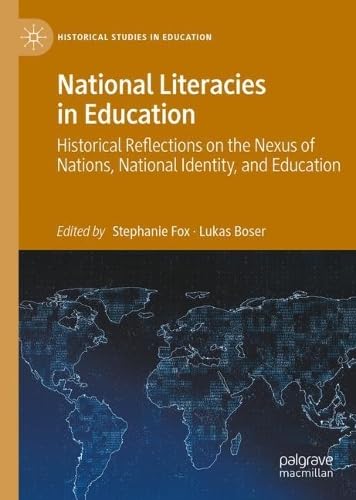
This post is an essay I wrote for a festschrift volume in honor of my dear friend and colleague, Daniel Tröhler, who is a professor at University of Vienna. The book is
An earlier version of this essay, “The Fraught Connection between State and School,” was published in 2022 in Kappan. Here’s a link to that piece. And here’s a link to the chapter version.
The book version is framed as the concluding chapter to the essays in the book, so it runs through a summary of the volume’s central themes and then turns to my own take on how what Tröhler calls national literacies are a reflection of the complex interaction between states and schools.
One theme that arises from these chapters is that while national literacies are distinctive from each other, that does not necessarily mean they are parochial. A number of these studies trace the way key components of national literacies are capable of traveling across national borders in remarkably complex ways. These are not simple cases of copying patterns from elsewhere, however. Instead of adopting foreign concepts, national school systems are more likely to adapt these concepts to fit into the already existing literacy within a nation. As a result, national literacies are distinctive but not unique. They share a lot of elements of political and religious culture while at the same time maintaining national character.
Another theme in the book and in Tröhler’s work in general is that, by seeing the construction of national literacies as a central component of why we have schools and of what schools do, we are at the same time defining a much broader and richer purview for the academic field of education than what is currently the norm in educational research organizations and journals. Most of the field of education today is focused on producing studies that are intended to help reengineer the educational system and educational profession in order to meet current societal policy objectives. This defines educational researchers as functionaries in the ongoing, massive enterprise of public education. We’re supposed to help tinker with the system in order to make it a more efficient and more effective agent for public policy. We’re trying to make schools better at increasing economic productivity and GDP and to deploy education effectively in the effort to solve a large array of social problems, such as ameliorating social inequality, improving public health, fending off foreign challenges, and reducing crime.
Here’s an overview of my argument:
The nation state and the public school grew up together during the 19th century, with each enabling the development of the other. Public schools gave the emerging nation state a way to turn subjects of the crown into citizens of the state by drawing a dispersed, dissociated, and culturally heterogeneous populace into a civic community with shared experiences and a shared national identity. At the same time, the emerging nation state provided schools with the fiscal, ideological, and political support that enabled them to evolve into the massive public enterprise they are today. No nation, no school. No school, no nation.
But now in the 21st century, the relationship between state and school has become increasingly dysfunctional. They continue to need each other as much as before, but each is less able than before to meet the other’s needs.
Currently, schools serve three important functions for the state:
Legitimacy. The presence of public schools enables the state to portray itself as overseer of a fair system of social opportunity for its citizens. The meritocratic structure of schooling also provides a credible rationale for the social inequality among citizens by providing a structure for determining what jobs people deserve.
Economic productivity. Schools are also seen as the essential mechanism for producing the human capital the state needs to fuel economic growth.
Civic community. Schools remain an important factor in establishing and maintaining civic culture.
It turns out that schools are much more effective at accomplishing the first of these than the other two, although the first alone is more than sufficient to justify the state’s huge investment in schooling.
Bottom line:
States and schools: Can’t live with them, can’t live without them.
See what you think.
Reflections on States, Schools, and National Literacies
David Labaree
This book arose from an intellectual community fostered by Professor Daniel Tröhler, and the contributors to this volume are members of this community, who have shared a rich set of conversations over the years about what Tröhler calls “national literacies.”
In this final chapter, my assigned task is to synthesize the analyses from the first 16 chapters and tie them up into a neat bundle. Good luck with that. Trying to develop a succinct summary of this book is a fool’s errand or certainly well beyond my limited abilities. And even trying to do this would be grossly unfair to the empirical and analytical richness of the wide array of contributions to the book.
What I decided to do instead is something less ambitious but possibly more useful – to write a reflective essay spelling out some of the thoughts that these 16 chapters provoked in me as a reader and member of the community. After all, the best research is a provocation. It compels you to think about familiar issues in fresh ways; and that is certainly the effect that this book has had on me.
My plan, therefore, is to do the following. First, I give a brief overview of some of the central themes that run through these insightful and diverse analyses of national literacies. Then I try to extend the historical framework of these studies up to the present, looking at how national literacies have adapted to the contemporary world well beyond the context of nation formation in which they first arose.
National literacies are both embedded in and created by national systems of schooling. Everyone knows that schools promote literacy in the literal sense, teaching the young how to read and write the local language. It’s in this form that we talk about the level of literacy in a particular country. But schools are also places that construct and instruct a national literacy, which constitutes the shared language of political discourse and of national identity. This is the language that gives meaning to the imagined community of citizens in a nation state.
The construction of national literacies is grounded in a broad and foundational relationship between schooling and the nation state.
The nation state and public schools grew up together, with each enabling the development of the other and with each serving as the precondition for the other. No nation, no school. No school, no nation. Systems of public schooling gave the emerging nation state an institutional mechanism for turning subjects of the crown into citizens of the state, by forming a common culture and shared experience that would draw a dispersed, dissociated, and culturally heterogeneous populace into a civic community with a shared national identity. At the same time, the emerging nation state provided schooling with the fiscal, ideological, and political support that enabled schools to evolve into a massive public enterprise, which has come to consume so much of the time and treasure of modern societies. (Labaree, 2022, p. 35)
In this way, nationality is tied up with personal identity. Your nation is not just where you live, it’s who you are. You’re Swiss, French, Swedish, or American. And these identities are formed in national systems of schooling, where students learn the language of membership in a civic community, a language that is deeply imbued with the values and norms of that community.
Individual contributions to this book demonstrate the variety of approaches that researchers can take in trying to understand more fully the nature of national literacies and the nation-school relationship across national boundaries. For just as nations differ, so do school systems. Different national literacies arise from different kinds of schooling in the different nations, with the nations serving as both cause and effect of these systems of schooling. The chapters examine a wide range of national settings within which these national literacies emerge, including: Argentina, France, Germany, Switzerland, Israel, Norway, Turkey, Sweden, United Kingdom, and United States.
One theme that arises from these chapters is that while national literacies are distinctive from each other, that does not necessarily mean they are parochial. A number of these studies trace the way key components of national literacies are capable of traveling across national borders in remarkably complex ways. These are not simple cases of copying patterns from elsewhere, however. Instead of adopting foreign concepts, national school systems are more likely to adapt these concepts to fit into the already existing literacy within a nation. As a result, national literacies are distinctive but not unique. They share a lot of elements of political and religious culture while at the same time maintaining national character.
Another theme in the book and in Tröhler’s work in general is that, by seeing the construction of national literacies as a central component of why we have schools and of what schools do, we are at the same time defining a much broader and richer purview for the academic field of education than what is currently the norm in educational research organizations and journals. Most of the field of education today is focused on producing studies that are intended to help reengineer the educational system and educational profession in order to meet current societal policy objectives. This defines educational researchers as functionaries in the ongoing, massive enterprise of public education. We’re supposed to help tinker with the system in order to make it a more efficient and more effective agent for public policy. We’re trying to make schools better at increasing economic productivity and GDP and to deploy education effectively in the effort to solve a large array of social problems, such as ameliorating social inequality, improving public health, fending off foreign challenges, and reducing crime.
As the studies in this book demonstrate, however, the field of educational research has bigger fish to fry. We’re not just trying to repair the machinery of public education. We’re striving to understand why these systems came into existence in the first place and why we continue investing such vast amounts of time and treasure to keep these systems going. This moves education away from a narrow utilitarian frame and toward a broader examination of the way that school and nation have continually served to construct each other through the medium of national literacies. And this in turn means digging into the way schools shape how we think, how we relate, and who we are. Such a vision of education as an academic field takes an approach to its subject that is profoundly historical. We can’t understand school and state without figuring out how they came into existence in a process of co-creation. And we can’t understand who we are as citizens without examining how we came to be.
So let me build on the core historical approach to education demonstrated by the contributions in this book by linking the discussion of national literacies to the more recent history of state and school. Yes, schools are critically important for the process of founding a nation state. But consider the role that the production of national literacies in schools plays after the state is comfortably established. When the state’s existence is no longer in jeopardy and national identity is firmly forged, what role if any does schooling continue to provide for the state? And once schooling is solidly institutionalized and thoroughly integrated into the life course of a nation’s citizens, in what ways does it still need the state that created it?
The second question is easier to answer than the first. Modern systems are massively expensive institutions that require gobs of government money in order to maintain themselves. But the answer to the first question is more intriguing for our purposes. So let’s examine it more closely.
I suggest that there are three forms of national literacies that continue to be essential for modern nation states to survive and thrive: the language of community; the language of productivity; and the language of legitimacy. As we will see, one key problem is that the third language undercuts the first. In this discussion, I’m going to be drawing on the example of the United States, which is the case that is most familiar to me.
Developing the language of community continues to be a central component of what school does for the state, long after the state is well established. As Benedict Anderson has shown, there is nothing natural about national identity and no obvious reason for why individuals scattered across a large country should feel a strong connection with total strangers who are hundreds of miles away. It takes schools to perform the alchemy that turns these strangers into fellow citizens. And this need doesn’t disappear over time. Young people who continually enter into a society need to learn this connection anew and so do recent immigrants from other countries. And schools in established states continue to play this role effectively. They draw all young people in the community into a single institutional setting, expose them to a common curriculum and a shared experience of social learning, and connect these students to the core beliefs, political principles, and civic culture that constitutes that state’s national literacy.
The language of community is most effectively learned in the most communal component of the school system, and that is the lower grades. It’s here that the academic curriculum is focused on the general skills of literacy and numeracy and the nonacademic curriculum aims to develop the norms and values needed to get along in society outside the family. It’s also here that learning is most likely to occur in a single classroom with a single teacher over the course of a year. It’s where students are all the same age, and thus where students from diverse family backgrounds find themselves developing into a single group of, say, third-graders, who then move on next year as a group to become fourth-graders. It’s hard to think of an institutional structure that is better suited to promote communal literacy. But, as we will see, this communal structure shifts over the years into a more differentiated and stratified structure in high school and even more so in university. The result is that higher levels of schooling can pose a significant threat to the language of community and to a shared civic culture.
Consider another form of literacy focused on productivity. Schools were initially established for the political aim of forming the nation state, but then they began to accumulate additional social functions that weren’t present at the beginning. One of these is that they come to be seen increasingly as places for learning the skills that students will need in order to play productive roles in the workforce. This economic role for schooling came rather late in the game. Throughout the nineteenth century, school enrollments were expanding rapidly in the US, as students came to stay an ever increasing part of their lifetimes in school. By 1900, the average teenager in American had accumulated 8 years of schooling.
But this growth had nothing to do with an economic demand for better educated workers, since during the same period industrialization was steadily reducing the skill level of the workforce. You no longer needed to hire people who knew how to make a shoe; you only needed people who could produce one small part of the process along the assembly line. However toward the end of the century, once the corporate structuring of industry required a large managerial bureaucracy – filled with clerks, managers, engineers, and the like – demand emerged for workers who had developed higher level verbal and computational skills and who thus could perform this new white collar work. The result was a boom in growth of education at the high school and college level. Industry needed these skills, and individuals had a strong incentive to acquire them in order to work in the new, clean, safe, respected, and well-paid white-collar occupations.
School became the place that fostered the language of productivity, which has come to dominate the rhetoric of educational policy across the globe. It is now customary for political leaders, policymakers, and pundits to talk reverently about the need to invest in education. The idea is that this investment will pay off in the form of workplace productivity, economic growth, and national power. In addition to making loyal citizens, we see ourselves as producing human capital. In the US, we find this language permeating educational reform efforts such as the 1983 A Nation at Risk report and the 2002 No Child Left Beyond Act. It’s also rife in the literature of OECD, and it lies at the heart of the PISA program, OECD’s global testing regime, which is designed to push nations to adhere to the new human capital gospel: Schools are the engines of economic growth.
A third literacy that is emergent from contemporary schools is the language of legitimacy. Even in an authoritarian state, force alone is not sufficient to maintain control. States in general need a compelling rationale that justifies their rule. For the Roman empire, it was bread, circuses, and protection from enemies. In the modern state, the key emerging issue is fairness. Modern societies are supposed to be guided by the achievement principle, which decrees that social position should arise not from the accident of birth but from the demonstration of individual merit. And schools are ground zero for the development and maintenance of this new meritocracy. They are the ideal instrument for promoting, measuring, and certifying personal achievement, with school credentials becoming the formal criterion for allocating people to jobs and thereby establishing their positions in the social hierarchy, where rewards are much higher at the top than the bottom of the system. As long as schools are able to promote the belief that these inequalities are justified according to individual merit, however, this system of inequality acquires the aura of fairness. Everyone has a chance to get ahead, and the state that oversees this system has earned its right to rule. Through schools, the state makes sure that people get what they deserve thus assuring the state’s legitimacy.
The problem, however, is that the meritocratic language of legitimacy seriously undermines the democratic language of community. Part of the issue is that meritocracy fosters an extreme form of inequality, reinforced by the principle of just deserts. Citizenship can tolerate a degree of inequality, but it still depends on the ideals that every citizen gets one vote and that all citizens are equal before the law. But the school-based meritocracy produces radical differences in income, wealth, and health between the top and bottom of the system. Life’s ugly in the basement.
More significantly, however, for the welfare of both school and state, is that the meritocracy not only glorifies the winners in the academic contest for the best credentials; it also demeans the losers. It defines people who are less successful in the game of schooling as performing jobs that are less worthy of respect. Just as your state is not just where you live but who you are, so too your credential level measures not just how you did in school but also defines your worth. The division is sharpest between those who have a college degree and those who don’t. The latter – no matter how essential their contribution is for the functioning of economy and society – are seen via the meritocratic language of legitimacy as beneath contempt. You only need to look at the growing political divide in countries around the world to see the dire effects of this invidious distinction in educational credentials.
So as state and school have matured over the years, the state has continued to be dependent on the school – not only to promote community but also to promote productivity and legitimacy. Even though these functions are often at cross purposes with each other, they nonetheless remain critically important for the state’s institutional viability. As a result, the states have not just maintained support for public schools but have sharply increased the level of this support. They have augmented the legitimacy of schools, which comes from being officially authorized by the state, by making it mandatory for all young people to attend them. And at the same time they have steadily ramped up the public funding of schooling to a remarkable – even possibly unstainable – level.
Consider the current fiscal burden that schools impose on the public purse. In the 50 American states, which are the primary funders of education, the cost of elementary, secondary, and higher education consumes more than one-third of the entire state budget. How did the cost grow so high? The key reason is that the average level of schooling in the population has been rising steadily over the last 200 years while the cost of schooling per student at each higher level of the system has been markedly greater than the level below. At one teacher per class, elementary schooling is a relative bargain. But as the number of teachers per class increases in middle and high school, so does the overall cost. When you get to undergraduate education, the number of faculty and the size of the infrastructure required for the same number of students jumps up by another large increment. And then there’s graduate school, the most labor intensive part of the system. Over time, the rate of increase in years of schooling per person has risen arithmetically while the rate of increase in cost of schooling per person has risen geometrically. In the US, this has led to an ongoing fiscal crisis and to populist efforts to roll back taxes and mandate greater accountability for schools.
In summary, therefore, the recent history of state and school has demonstrated that they need each other more than ever but that their once untroubled relationship has become increasingly fraught. They can’t live with each other and can’t live without each other.
Labaree, David F. (2022). The fraught connection between state and school. Kappan, (January), 104:4, 34-40.
 David Labaree on Schooling, History, and Writing