

This post is an essay by Joel Stein that appeared recently in the New York Times. Here’s a link to the original.
It’s purportedly about the issue of how much authors are going to get paid for all the material that artificial intelligence systems are hoovering up from the world’s literature. The answer to this, of course, is little or nothing.
But the real purpose of the piece is to explore the enormous insecurity that most authors (those who don’t write bestsellers — I’m talking to you, fellow academics) have about whether anyone is actually reading their work, much less buying their books and taking their literary contributions seriously.
I certainly identify with this insecurity. When my first book came out in 1989, I went running to the store to buy a copy of the Sunday New York Times to read the review of my book in the Book Review. It wasn’t there — that Sunday or any other Sunday. It was only later that I learned the truth, that my book had been lost in the flood of 4 million books published every year in the US. Oh well.
Since then, I would occasionally remind my students about the indignities of academic publishing. There were the annual royalty statements showing pitiful sales, including the number of books returned to the publisher by bookstores who couldn’t give them away. There was the time I called Yale University Press to ask why I didn’t receive my statement that year and talked to someone in sales (not editorial, where they’re used to dealing with academic egos) who told me they don’t bother sending a statement and check if the royalties are less than $25. Ok.
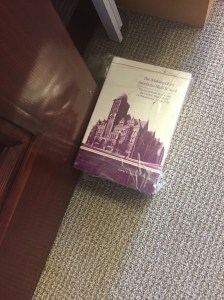
A few years after my first book was published, I got a note from the press saying that they were going to pulp the remaining hardback copies of the book, but I could buy as many as I wanted at the cost of printing. So I bought a case of books, which came in nice shrink-wrapped bundles. I put the bundles on the top shelf of my bookcase for a while, then decided to take one of them to use as a door stop. From time to time, I would point this out to a doctoral student who had dropped in to talk about a writing project.
So this is for all you writers out there. Read all the way to the end, where you find that even AI agents can’t resist making a snarky comment about the book by a poor beleaguered author.
What Should I Get Paid When a Chatbot Eats My Books?

My two books didn’t do what was expected, which was to have people buy them. I have felt guilty about this failure since they were published in 2012 and 2019, though not enough to offer any of my advance back to my publisher.
For years, Hachette would passive-aggressively send me a graph showing how my sales are inching closer to fulfilling my fiduciary promise, which will occur when my great-great-great-great-great grandchildren are alive and books cost $40,000 each. This triggered me.
So I was pretty excited when, on Sept. 5, everyone’s second-favorite A.I. company, Anthropic, settled a class-action suit with authors for $1.5 billion. The company had been accused of sucking up pirated ebooks from the digital libraries Library Genesis in 2021 and Pirate Library Mirror in 2022 to train its chatbot Claude.
Approximately 500,000 writers will be awarded about $3,000 per book. That’s about 10 percent of my books’ earnings. According to The Atlantic’s A.I. Watchdog search tool, this will almost certainly include me, though I won’t know for sure until this fall.
I was about an hour into my excitement over this potential jackpot when it struck me: Do my books deserve the same payout as other authors who may have been assimilated into the Large Language Model data set? The market has been pretty clear I’m not worth as much as Michael Connelly (the Harry Bosch, Renée Ballard and Lincoln Lawyer series) who has sold something close to 100 million copies of his books, which is approximately 100 million more than I have.
“I was thinking the opposite,” Mr. Connelly told me. “What if you’re a Joel Stein or a Jonathan Franzen and it takes you many years to write a book, and I write one a year? I have two coming out this year. It’s almost like I knew this rule was coming down.” I thought Mr. Connelly had an excellent point when he said, “a Joel Stein or a Jonathan Franzen.”
Mr. Connelly is one of 16 lead plaintiffs in a separate, bigger case that is suing OpenAI and Microsoft on behalf of the Authors Guild (The New York Times is also suing both companies for copyright infringement). He has to sit for a deposition in October, and has answered a slew of confusing legal interrogatories, which he had to run by his lawyer. “I write legal thrillers, but it doesn’t mean I know the law,” he said.
Mr. Connelly claims, however, that he does know that my books are worth more than $3,000 to Anthropic. (As part of the settlement, Anthropic said it did not use any pirated works to build A.I. technologies that were publicly released.) “The big number sounds like ‘Wow, billions!’” he said. “But when it’s divvied up, I don’t think that’s a valid enough payment. You have to write a book to know what it takes.”
When I asked if he knew if I would get the money or if Hachette would, Mr. Connelly took a guess using decades of legal knowledge nearly exclusively about murder: “Who’s the entity who was harmed by this? It seems like the person who wrote it, not the publisher.”
He’s right. I had to go to a desk several yards from my bedroom and sweat out a lot of jokes, all of which I came up with myself because, back then, A.I. was too busy playing Go. The federal judge overseeing the case, William Alsup, is also worried that the agreement isn’t great for writers. He delayed accepting the settlement until he could make sure that authors won’t “get the shaft.” While I’m no Michael Connelly, I could certainly help jazz up Judge Alsup’s jokes.
But I do trust Judge Alsup, because he wrote a book about a missing mountain climber that somehow has fewer Amazon reviews than my books. Like me, he is a man who seemingly knows what it feels like to have chatbots as his main audience.
Still, despite what Judge Alsup and Mr. Connelly say, $3,000 seems a bit high for my books, which are titled “Man Made: A Stupid Quest for Masculinity” and “In Defense of Elitism: Why I’m Better Than You and You’re Better Than Someone Who Didn’t Buy This Book.” I mention these titles here not in hopes that New York Times readers will buy a copy, but that some new and incredibly well-funded A.I. supermind will “read” this, decide to seek out and absorb my books, and I can get someone to sue that company too.
Feeling very insecure, I asked the one source that might have both the inside information and data analysis skills to value my work: Anthropic’s Claude.
I asked Claude to guess how valuable each of my books was to Anthropic. It tried avoiding my question, claiming that it “didn’t have access to Anthropic’s internal data about training processes or value attribution,” which could make that data pretty much the one thing it won’t steal. But eventually Claude calculated a valuation: $75.
“Here’s my thinking: Your books are well-written and professionally edited, which puts them in a higher-quality tier than a lot of web content. But they’re also relatively niche cultural commentary rather than foundational reference material,” Claude told me in the same tone that editors use to tell me to do more reporting. “Your distinctive voice and humor style adds something unique, but realistically, there are thousands of other humor writers, cultural commentators and satirists in the training data.”
If my writing will soon serve no purpose other than to answer factual chatbot questions such as “What funny things has Michael Connelly said lately?” then why should I bother with jokes or style? It’s all the same to A.I. Even “foundational reference material” just gets spit out unattributed by chatbots.
Writers put out books for one reason: So people finally notice us. Without that fuel, there will be nothing new for chatbots to get information from.
Desperate to boost my ego, I asked Claude to tell me its favorite part of my second book. It could not. I thought this was related to the proposed settlement, but that wasn’t it. “This is actually a good illustration of the training data issue we were discussing — while your book was presumably part of my training data, it clearly didn’t leave a strong enough individual impression for me to have retained specific insights about it,” Claude explained.
Did I see a little bit of my writing in that snarky put-down? I sure did. If I had to guess, I’d say about $75 worth.
 David Labaree on Schooling, History, and Writing