This post is an essay by Joel Stein that appeared recently in the New York Times. Here's a link to the original. It's purportedly about the issue of how much authors are going to get paid for all the material that artificial intelligence systems are hoovering up from the world's literature. The answer to this, of … Continue reading Joel Stein: What Should I Get Paid When a Chatbot Eats My Books
Category: Language
Frank Bruni — For the Love of Sentences
This post is a recent column by Frank Bruni in the times, part of his series "For the Love of Sentences." Here's a link to the original. Enjoy. For the Love of Sentences Image Credit...Chang W. Lee/The New York Times In The Autopian, Matt Hardigree explained one carmaker’s advantage: “You don’t buy a Subaru so much as you … Continue reading Frank Bruni — For the Love of Sentences
Frank Bruni — The Best Sentences of 2024
This post is a piece by Frank Bruni from the Times. Here's a link to the original. It's the new year, so it's time to take a moment to celebrate some the best writing that appeared in the last year. This is what Bruni has done here. In particular, he shows us his favorite sentences. I … Continue reading Frank Bruni — The Best Sentences of 2024
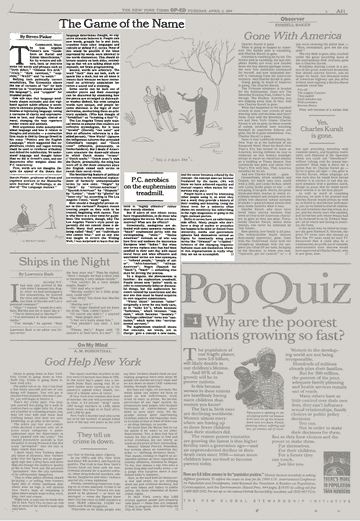
Steven Pinker — The Euphemism Treadmill
This post is an op-ed that Steven Pinker published in the New York Times in 1994. Here's a link to the original. It's about a tendency toward euphemism that was in its infancy back then but has how now become the new norm. The bewildering feature of political correctness is the mandated replacement of formerly unexceptionable … Continue reading Steven Pinker — The Euphemism Treadmill
Isaiah Berlin on Writing, Rhetoric, and Churchill
My blog post today is a fascinating essay by Isaiah about writing, rhetoric, and Winston Churchill, which was published in the Atlantic in 1949. I find it a rich think piece that works, I think successfully, to rescue Churchill from his critics. Here's a link to the original. He starts with a vicious attack on … Continue reading Isaiah Berlin on Writing, Rhetoric, and Churchill
Len Gutkin — The Hyperbolic Style in American Academe
This post is an essay by Len Gutkin that was recently published in the Chronicle Review. Here's a link to the original. The essay does a great job of capturing the essence of a new form of discourse on American university campuses he calls the "hyperbolic style" -- which he characterizes as "breathless, declaratory, at … Continue reading Len Gutkin — The Hyperbolic Style in American Academe
Rosemarie Ostler: The Early Days of American English
This post is a nice essay by Rosemarie Ostler about how American English evolved in the new world. It draws on her book, The United States of English, and first appeared in Lapham's Quarterly. Here's a link to the original. She shows how the American version of the language emerged from a variety of sources. Some … Continue reading Rosemarie Ostler: The Early Days of American English
John McWhorter — Forget Nouns. Verbs Are Where the Action Is
This post is a recent essay by John McWhorter from the Times. In it he explores an issue dear to my heart -- that dynamic writing is about action. It's the verbs not the nouns that matter most. Academic writing is dense with nouns and also with verbs that are turned into nouns (e.g., optimization, … Continue reading John McWhorter — Forget Nouns. Verbs Are Where the Action Is
Michael Massing: Avoid These Cliches Like the Plague
This post is a recent piece by Michael Massing from the New York Times. Here's a link to the original. The piece consists entirely of a remarkably inclusive list of common cliche's used by writers in English. An impressive display, I think you'll agree. As all writers know, it's hard to avoid using cliches. A cliche … Continue reading Michael Massing: Avoid These Cliches Like the Plague
George Packer: The Moral Case Against Equity Language
This post is an essay by George Packer from the April issue of Atlantic. Here's a link to the original. I find a thoughtful rumination on the problems posed by shifting to equity language in an effort to reduce discrimination and disparagement. The problem, he says, is that the effort tends to lead to euphemisms, which … Continue reading George Packer: The Moral Case Against Equity Language